Choosing the best type of Shelving Boards starts with what the shelf must hold, how far it must span, and where it will sit. A row of paperbacks creates a different load from a few folded towels. A garage shelf may face damp air, while a living-room unit needs a clean finish. There is no single board that suits every room.
Shelving materials consultant Lena Brooks puts it this way: “Choose the board for the load, the span, and the setting—not its appearance alone.” That rule is useful, though it is not the whole story. Solid wood offers a natural look and can be refinished, but its price and movement with humidity matter. Plywood is often strong for its weight, while particleboard can be budget-friendly but needs careful support and protection from moisture. Melamine-faced boards wipe clean, yet cut edges may need finishing.
Details matter. Check board thickness, support spacing, expected weight, and whether the shelf may get wet. A long, thin board can sag even when it looks sturdy in the store. And a heavier board is not automatically the better choice. Measure twice. Then compare the material with the actual job.
This guide explains common board types, their strengths, their trade-offs, and where each works best. It also considers cost, appearance, durability, and installation. The answer may feel less tidy than a simple winner. That is worth acknowledging: the best board depends on the shelf you are building.
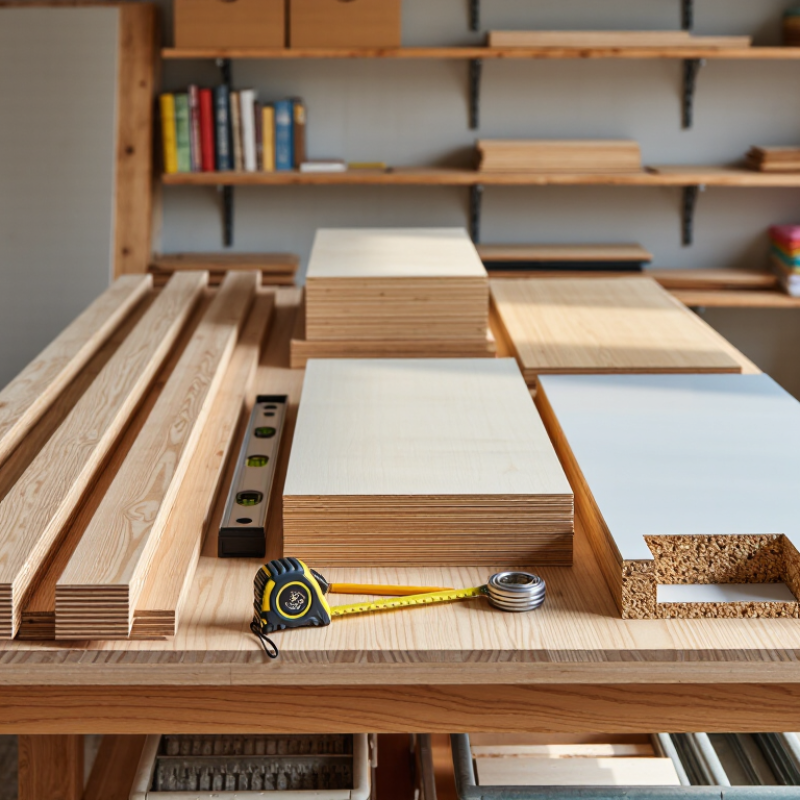
A shelf’s best material depends on its clear span, expected load, and acceptable sag. Measure the unsupported distance between supports. Count the real load: books, bins, and anything placed near the front edge. Then choose a deflection target. At L/240, allowable sag equals the span divided by 240. A 36-inch span therefore permits 0.15 inch of deflection under the chosen service load. Small number. Still visible across a long shelf.
L/240 is a practical benchmark, not a universal shelf rule. The USDA Forest Products Laboratory’s Wood Handbook (FPL-GTR-282, 2021) documents how wood stiffness varies with species, grade, and moisture content. The ANSI/AWC National Design Specification also provides design values for structural wood, but a shelf calculation must reflect its actual supports and loading. A centered stack of books differs from evenly distributed storage. So does a damp utility room. Engineered panels can offer consistent properties, yet thickness and span still matter. That part is easy to underestimate. Calculate sag for the full span and expected load, then leave some margin; L/240 may feel too flexible where appearance matters.
For shelving, span is the clear distance between supports, load is the weight carried by the shelf, and sag is its downward deflection. The common L/240 benchmark limits deflection to the span divided by 240—for example, 0.15 in at a 36 in span.
| Board material | Nominal board size | Clear span | L/240 sag limit | Estimated uniform load per shelf | Practical notes |
|---|---|---|---|---|---|
| Softwood lumber | 3/4 in thick × 12 in deep | 36 in | 0.15 in | About 125 lb | Stiffness varies with species, grade, grain, and moisture. Check for knots and defects. |
| Softwood lumber | 3/4 in thick × 12 in deep | 48 in | 0.20 in | About 70 lb | A longer span increases deflection quickly; a center support or thicker board can help. |
| Plywood | 3/4 in thick × 12 in deep | 36 in | 0.15 in | About 104 lb | Panel stiffness depends on grade, construction, and the direction of the face grain. |
| Plywood | 3/4 in thick × 12 in deep | 48 in | 0.20 in | About 59 lb | Often a versatile choice; support the panel securely along its edges. |
| Medium-density fiberboard (MDF) | 3/4 in thick × 12 in deep | 36 in | 0.15 in | About 52 lb | Has uniform surfaces but can sag under sustained loads; protect it from moisture. |
| Medium-density fiberboard (MDF) | 3/4 in thick × 12 in deep | 48 in | 0.20 in | About 29 lb | For heavier or long-term loads, shorten the span or add a stiffening support. |
| Particleboard | 3/4 in thick × 12 in deep | 36 in | 0.15 in | About 42 lb | Performance varies by panel grade; edges and fastener connections need suitable support. |
| Particleboard | 3/4 in thick × 12 in deep | 48 in | 0.20 in | About 23 lb | Long spans and sustained loads can cause noticeable sag; avoid moisture exposure. |
How to read the load estimates: These are illustrative, deflection-based estimates for a simply supported, 12 in deep shelf carrying a uniformly distributed load. They use representative assumed bending moduli of 1.2 million psi for softwood, 1.0 million psi for plywood, 0.5 million psi for MDF, and 0.4 million psi for particleboard. Actual properties vary, and L/240 is a sag criterion—not a guarantee of structural safety or a product load rating. Account for board grade, real thickness, support and fastening details, concentrated loads, and long-term creep; use a lower design load where these factors are uncertain.
There is no single best choice. Check the load, unsupported span, board thickness, and support spacing. A strong-looking shelf can still bow.
For a simply supported shelf under an even load, deflection rises with the fourth power of the span. Double the span, and sag can increase sixteenfold. That is easy to miss.
Solid wood can be stiff, but species, grain direction, and knots affect performance. Plywood’s cross-layered veneers help resist bending and splitting. Check its grade and thickness.
MDF has a smooth, uniform surface and can hold small items steadily. Long spans may sag, and ordinary grades are poorly suited to damp rooms.
Its exposed edges can swell, sometimes leaving a raised bump after a damp cup sits nearby. Seal cut edges where moisture is possible.
Steel can support slim shelves with high stiffness. Thin sheet metal may still flex under a heavy load. Thickness matters.
Measure between supports, not wall to wall. Add a center bracket to shorten the span, or consider a thicker board. I might check the load again.
Check the board’s moisture rating and protect cut edges. “Water-resistant” does not mean waterproof. Keep a little margin for changing loads and loose fasteners.
Choosing the best Shelving Boards starts with defining the shelf’s unsupported span, expected load, and acceptable sag. A common guideline is the L/240 benchmark: the shelf’s deflection should generally remain within one two-hundred-fortieth of its span under the intended load. Because beam theory shows that deflection under a uniform load increases with the fourth power of span, even a modest increase in shelf length can significantly affect stiffness.
Compare materials for both strength and conditions: solid wood and plywood can offer good stiffness, while MDF and particleboard may be more sensitive to moisture and need careful support; steel can suit demanding loads but may cost more. Check relevant panel grades against ANSI A208.1, ANSI A208.2, or APA PS 1 where applicable. The final choice should balance rated load, unsupported span, humidity exposure, and cost rather than relying on material name alone.

 FutureSpace Rack